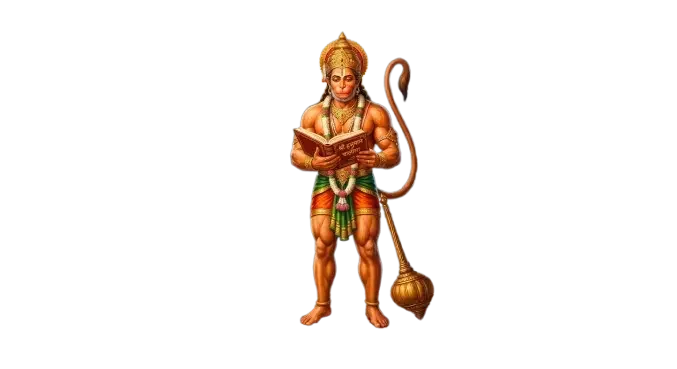
hanuman chalisa in english
If you are not good at Hindi like me and want to read Hanuman Chalisa in English, and understand the meaning of these beautiful times, you can read Hanuman Chalisa in English easily with meaning too and even download a pdf from here.
Complete Hanuman Chalisa in English Text with Roman Transliteration
Opening Doha of Hanuman Chalisa in English
“Shri Guru charan saroj raj nij manu mukuru sudhaari / Barnaun Raghubar bimal jasu jo daayaku phala chaari”
Literal meaning: “Cleansing the mirror of my mind with the dust of my Guru’s lotus feet, I narrate the pure glory of Raghubar (Lord Rama), which bestows the four fruits of life.”
Deeper meaning: Tulsidas begins not with Hanuman, not even with Rama — but with his Guru. This is a statement about the tradition of knowledge: the teacher-student lineage (Guru-Shishya Parampara) is the foundation of any genuine spiritual transmission.
The “mirror of mind” metaphor is profound. The Upanishads say the mind is like a mirror — when it is dusty with desires, ego, and ignorance, it cannot reflect the truth clearly. The Guru’s grace (symbolized by even just the dust from his lotus feet) is enough to clean that mirror.
“Phala chaari” — the four fruits — refers to the Purusharthas: Dharma (righteousness), Artha (material prosperity), Kama (fulfillment of desires), and Moksha (liberation). The implication is that Hanuman’s praise delivers all four simultaneously.
Opening Doha of Hanuman Chalisa in English
“Buddhiheen tanu jaanike sumiraun pavan-kumaar / Bal buddhi vidya dehu mohin harahu kalesh vikaar”
Literal meaning: “Knowing myself as possessing a body with limited intelligence, I meditate on the Son of Wind (Hanuman). Grant me strength, wisdom, and knowledge, and remove my suffering and impurities.”
Deeper meaning: This second doha is Tulsidas’s personal confession of limitation. He is not being falsely modest — he is following a tradition in Indian spiritual literature where the seeker acknowledges their own insufficiency before approaching the Divine. This humility is not weakness; it is the first step toward genuine grace.
“Pavan-kumaar” — Son of the Wind — is one of Hanuman’s most important epithets. Vayu, the Wind God, is Hanuman’s spiritual father. In Hindu cosmology, Vayu is the Prana (life force) that sustains all life. By calling Hanuman the son of Prana, Tulsidas is saying: Hanuman is the very life force of devotion.
The three things asked for — bal (strength), buddhi (wisdom), vidya (knowledge) — represent the three dimensions of complete human development: physical/courage, mental/intelligence, and spiritual/learning. And the two things asked to be removed — kalesh (suffering) and vikaar (impurities/sins) — represent the two categories of problems: external suffering and internal moral staining.
This doha alone is worth years of meditation. Now Hanuman Chalisa in English is starting from here:
Chaupai 1: “Jai Hanumaan gyaan gun saagar / Jai Kapees tihun lok ujaagar”
Literal meaning: “Hail Hanuman, ocean of wisdom and virtue / Hail Lord of monkeys, illuminator of the three worlds.”
Deeper meaning: The first chaupai opens with a victory cry — “Jai” — which in Sanskrit means both “victory” and “glory.” This is a greeting of supreme respect, used when addressing kings and gods.
“Gyaan gun saagar” — ocean of wisdom and virtue — is a tremendous description. Hanuman is not just strong. He is not just brave. He is an ocean of gnana (knowledge) and guna (quality/virtue). The ocean metaphor is deliberate: oceans are inexhaustible, ancient, and the source of life. Hanuman’s wisdom is not a puddle or a pond — it is a limitless ocean.
“Kapees” — Lord of the Vanaras (monkey people) — is a title that speaks to Hanuman’s leadership. He is not just a servant or a soldier. He is a king among his kind.
“Tihun lok ujaagar” — illuminator of the three worlds. In Hindu cosmology, the three worlds are Bhuloka (earth), Bhuvarloka (atmosphere/astral plane), and Swargaloka (heaven). Hanuman’s glory illuminates all three simultaneously.
Chaupai 2: “Raam doot atoolit bal dhaama / Anjani-putra Pavansut naama”
Literal meaning: “Messenger of Rama, abode of incomparable strength / Son of Anjani, known as the Son of the Wind.”
Deeper meaning: “Raam doot” — Messenger of Rama — is arguably the most important title for Hanuman. He is the ambassador, the envoy, the divine messenger. In Valmiki’s Ramayana, when Hanuman first meets Sita in Lanka, he introduces himself precisely this way: “I am Rama’s messenger.” This is how he defines himself — not by his own power, but by whom he serves.
“Atoolit” means incomparable, beyond comparison. Not just strong — beyond all comparison of strength. This is significant because Tulsidas is saying that Hanuman’s strength is not on a scale with other beings. It is in a category by itself.
Two birth-names are given: “Anjani-putra” (son of Anjani, his mother) and “Pavansut” (son of Pavan/Vayu, the Wind God). Why are both given? Because Hanuman has two parentages — one physical (Anjani, the vanara woman) and one spiritual/cosmic (Vayu, the cosmic breath). This dual nature — fully in the world yet fully connected to the cosmic — is the paradox and beauty of Hanuman.
Chaupai 3: “Mahaveer vikram bajrangi / Kumati nivaar sumati ke sangi”
Literal meaning: “Great hero, valiant, with a body like lightning / Remover of evil intellect, companion of good intellect.”
Deeper meaning: “Bajrangi” is one of Hanuman’s most beloved epithets. “Bajra” means thunderbolt or diamond — the weapon of Indra (king of gods), but also a metaphor for something indestructible and piercing. “Angi” means “embodied.” So Bajrangi means “one whose body is like a thunderbolt” — a body that cannot be destroyed, that pierces through all obstacles.
The most profound line here is “kumati nivaar, sumati ke sangi” — remover of bad intellect, companion of good intellect. This is not about intelligence in the IQ sense. “Mati” here means the orientation of the mind — what the mind is inclined toward, what it values, how it perceives. “Kumati” is a mind oriented toward selfishness, delusion, cruelty, greed, or confusion. “Sumati” is a mind oriented toward truth, compassion, wisdom, and devotion.
Hanuman doesn’t just add good qualities. He removes the bad ones first. This sequencing matters in spiritual practice: purification before illumination.
Chaupai 4: “Kanchan varan biraaj subesa / Kaanan kundal kunchit kesa”
Literal meaning: “Resplendent with golden complexion, wearing fine clothing / Wearing kundalas (earrings) in the ears, with curly hair.”
Deeper meaning: This and the next chaupai are dedicated to Hanuman’s physical description — his divine form (swarupa). In Hindu worship, the description of the deity’s form is itself a meditation. When you visualize Hanuman’s golden complexion, his curly hair, his earrings, his weapons — you are performing dhyana (meditative visualization).
“Kanchan varan” — golden complexion. Hanuman’s body is golden, the color of the sun, the color of fire. In Hindu symbolism, gold represents purity, divinity, and the higher self. By giving Hanuman a golden body, the tradition is saying: he is the embodiment of the divine itself in physical form.
The earrings (kundalas) are particularly significant — they represent the Kundalini energy, the serpent power coiled at the base of the spine in yogic anatomy. A being who wears kundalas is one in whom the Kundalini has risen to its full height.
Chaupai 5: “Haath bajra au dhvaja birajai / Kaandhe munja janeu saajai”
Literal meaning: “In his hands shine the thunderbolt and the flag / On his shoulder is adorned the sacred thread of munja grass.”
Deeper meaning: The weapons and symbols Hanuman carries are a visual theology:
- Bajra (thunderbolt): Power, invincibility, the ability to destroy negative forces instantly
- Dhvaja (flag/banner): Victory, the assertion of dharma’s supremacy
- Munja janeu (sacred thread): This is the most surprising detail. The janeu (yajnopavita) is the sacred thread worn by initiated Brahmins. For Hanuman — a vanara — to wear it is an assertion that spiritual initiation transcends birth and caste. Hanuman is a Brahmin by virtue, not by birth.
This chaupai contains a subtle but important social message: the sacred thread (and all it represents — access to Vedic knowledge, ritual purity, spiritual authority) belongs to the worthy, not merely the born.
Chaupai 6: “Shankar suvan Kesari nandan / Tej prataap mahaa jag vandan”
Literal meaning: “Son of Shankar (Shiva), beloved son of Kesari / With great radiance and power, worshipped by the world.”
Deeper meaning: This chaupai contains the most profound theological statement in the Hanuman Chalisa: that Hanuman is the son of Shiva (“Shankar suvan”). How is this possible if Vayu is his father?
Different traditions handle this differently. The Shiva Purana states that Shiva himself took the form of the eleventh Rudra and incarnated as Hanuman. Parashar Samhita supports this. The Ananda Ramayana describes how Shiva’s divine essence combined with Vayu to create Hanuman’s birth.
The significance is enormous: if Hanuman is an avatar of Shiva, then worshipping Hanuman is simultaneously worshipping the supreme Shaiva divinity. This allows both Vaishnavas (who come to Hanuman through Rama) and Shaivas (who honor Shiva) to find their deity in Hanuman. He becomes a theological bridge between two great streams of Hindu devotion.
“Kesari nandan” — son of Kesari. Kesari was the vanara king who was Hanuman’s human/earthly father. So Hanuman has three fathers: Shiva (spiritual essence), Vayu (cosmic breath/life force), and Kesari (earthly father). This tri-paternal origin makes him simultaneously transcendent, cosmic, and earthly — present on all three planes.
Chaupai 7: “Vidyaavaan guni ati chaatur / Raam kaaj karibe ko aaatur”
Literal meaning: “Learned, virtuous, extremely clever / Ever eager to accomplish Rama’s work.”
Deeper meaning: In Sanskrit scholarship, Hanuman is considered the greatest scholar among the divine beings. The Valmiki Ramayana explicitly says that Hanuman had mastered all four Vedas, six Vedangas, and all 64 arts (kala). When Rama first meets Hanuman, he says to Lakshmana: “This person has clearly mastered all the Vedas. His grammar is flawless, his speech moves like an ocean. There is nothing in the three worlds he does not know.”
“Ati chaatur” — extremely clever/wise. This is not cleverness in a manipulative sense, but the wisdom to know exactly what to do in every situation. Hanuman always knows the most effective action.
But the most important phrase is “Raam kaaj karibe ko aaatur” — eager, almost impatient to do Rama’s work. All his learning, all his power, all his wisdom — none of it exists for his own aggrandizement. It exists to serve. This is the model of true intelligence: intelligence in service of something beyond yourself.
Chaupai 8: “Prabhu charitra sunibe ko rasiya / Raam Lakhan Sita man basiya”
Literal meaning: “Relishing hearing the deeds of the Lord / With Rama, Lakshmana, and Sita living in his heart.”
Deeper meaning: “Rasiya” is a beautiful word — it means one who savors, one who experiences rasa (the aesthetic-spiritual flavors of existence). Hanuman is a rasika — a connoisseur — of Rama’s story. He doesn’t listen to Rama’s deeds as data to be processed. He relishes them as a devotee savors every word.
“Raam Lakhan Sita man basiya” — Rama, Lakshmana, and Sita dwell in his heart/mind. The famous story: when Hanuman was asked to prove his devotion, he tore open his chest to reveal Rama and Sita literally residing in his heart. This verse is the textual basis for that imagery.
Why all three — Rama, Lakshmana, and Sita? Because they represent a complete divine reality: Rama is the Supreme Consciousness, Sita is the Divine Feminine/Creation, and Lakshmana is selfless service/ideal brotherhood. For completeness, all three must dwell in the devotee’s heart.
Chaupai 9: “Sookshma roop dhari siyahin dikhaava / Bikat roop dhari lank jaraava”
Literal meaning: “Taking a subtle form, he appeared before Sita / Taking a terrible form, he set Lanka ablaze.”
Deeper meaning: This verse describes Hanuman’s two modes during his visit to Lanka — the epitome of strategic intelligence. When he found Sita in the Ashoka grove, surrounded by rakshasa guards, Hanuman appeared in a tiny form so as not to frighten her. He approached with gentleness, humility, and compassion. But when the rakshasas captured him and tried to humiliate him, when Ravana tried to burn him — he expanded into a terrifying form and set the entire golden city of Lanka on fire.
The spiritual teaching: the wise being knows when to be small and when to be vast, when to be soft and when to be fierce. Hanuman didn’t burn Lanka because he was angry. He did it to demonstrate a point — that even Ravana’s invincible fortress was powerless before Rama’s devotee.
“Sookshma” (subtle) and “bikat” (terrible/vast) represent the two poles of divine power: the capacity to be infinitely small and the capacity to be infinitely large. This is the nature of consciousness itself — it can contract into a single point or expand into infinity.
Chaupai 10: “Bheem roop dhari asur sanhaare / Raamchandra ke kaaj sanvaare”
Literal meaning: “Taking a fearsome form, he destroyed the demons / And made all of Ramachandra’s tasks successful.”
Deeper meaning: “Bheem roop” — the form like Bhima (the Pandava). This comparison is deliberate. Bhima and Hanuman are half-brothers (both sons of Vayu). When Bhima encounters the aged Hanuman in the Mahabharata, Hanuman teaches Bhima humility by showing him that even now he is beyond Bhima’s strength. The “Bheem roop” thus means an incomprehensibly powerful physical form.
“Kaaj sanvaare” — made the tasks successful. Everything Hanuman does is in service of a larger purpose. His destruction is not gratuitous. When he kills demons, it is not for sport or glory — it is to “sanvaare” (arrange, organize, make successful) Rama’s mission. This purposefulness is what distinguishes sacred power from mere brute force.
Chaupais 11-13: The Great Praise by Rama
Chaupai 11: “Laay sanjeevan Lakhan jiyaaye / Shri Raghubird harashi ur laaye”
When Lakshmana was struck down by Meghnad’s (Indrajit’s) deadly weapon in the battle of Lanka, Hanuman flew to the Himalayas to bring the Sanjeevani herb. Unable to identify the specific herb, he lifted the entire mountain and brought it back. Lakshmana was revived. Rama, overjoyed, embraced Hanuman to his chest — an extraordinary gesture from God toward his devotee.
Chaupai 12: “Raghupati keenhi bahut badaayi / Tum mam priya Bharatahi sam bhaai”
Rama praised Hanuman extensively and said: “You are as dear to me as my brother Bharata.” Bharata is considered the ideal brother in Hindu tradition — the one who ruled not from the throne but from Rama’s sandals, refusing to sit on the throne himself in Rama’s absence. To be compared to Bharata is the highest compliment Rama could give.
Chaupai 13: “Sahas badan tumharo jas gaavain / As kahi Shripati kanth lagaavain”
Rama says: “The Thousand-Headed Serpent (Sheshanaga) sings your glory” — and saying this, he (Shripati, Lord of Lakshmi, another name for Vishnu) embraced Hanuman to his throat/heart.
When Vishnu himself embraces Hanuman, when he publicly declares that the thousand-headed cosmic serpent (who supports the entire universe) praises Hanuman — the theological status of Hanuman is being raised to the highest possible level. This is not a demon-slayer or a soldier. This is a being praised by the entire cosmos.
Chaupais 14-15: The Cosmic Choir of Praise
These two chaupais list all the beings of the universe who sing Hanuman’s glory:
- Sanaka, Sanatana, Sanatkumara, Sanandana (the four mind-born sons of Brahma, who are eternal celibate sages)
- Brahma, Indra, the great sages
- Narada (the divine musician and messenger)
- Saraswati (goddess of knowledge and arts)
- Shesha (the cosmic serpent)
- Yama (god of death), Kubera (god of wealth), the eight directional guardians (Ashtadikpalas)
- Poets and scholars of all kinds
The point: every being of consequence in all three worlds praises Hanuman. If even Yama (death), Kubera (wealth), and the cosmic serpent Shesha praise him, what can human poets add? Tulsidas humbly acknowledges: “What can poets and scholars say [that would be adequate]?”
This rhetorical question is actually a profound acknowledgment: Hanuman’s glory exceeds all human capacity for description. Every word of praise falls short.
Chaupai 16-17: The Great Services to Others
Chaupai 16: Hanuman helped Sugriva — the exiled monkey king who had lost his kingdom, his wife, and his confidence. Hanuman introduced Sugriva to Rama, creating the alliance that would eventually lead to Lanka’s defeat. Because of Hanuman’s initiative, Sugriva regained his kingdom and his dignity.
Chaupai 17: Vibhishana — Ravana’s own brother, a righteous man trapped in a demon’s court — listened to Hanuman’s counsel when Hanuman visited Lanka. Hanuman advised Vibhishana to abandon Ravana and surrender to Rama. Vibhishana followed this advice, was accepted by Rama, and after the war became the king of Lanka. “All the world knows this,” says Tulsidas — it is public knowledge, not secret.
Both these stories carry the same message: Hanuman doesn’t just help people spiritually. He intervenes in the real world to create real change — thrones restored, righteous people elevated to their proper positions.
Chaupai 18: The Swallowing of the Sun
“Yug sahastra jojan par bhaanu / Leelyo taahi madhur phal jaanu”
“The sun is thousands of yugas away in yojanas / [As a child, Hanuman] swallowed it, thinking it to be a sweet fruit.”
This verse refers to one of the most famous Hanuman childhood stories. As a child, Hanuman was hungry and saw the sun in the sky. Thinking it was a big, red, delicious fruit, he leaped into the sky and tried to swallow it. The gods were alarmed. Indra struck Hanuman with his thunderbolt, injuring his jaw (which is why he is called Hanuman — “hanu” means jaw in Sanskrit).
But beyond the charming story is a profound yogic statement. The verse says “yug sahastra jojan” — thousands of yugas in yojanas. A yuga is a cosmic time-unit; a yojana is a distance unit. Modern commentators have attempted calculations: if we take specific traditional values, this could approximate the actual distance from the Earth to the Sun (roughly 150 million kilometers). Whether or not this was intentionally encoded, the verse attributes to the sun an extraordinary distance — and says Hanuman covered that distance as a child in a single leap.
The spiritual meaning: Hanuman’s power and capacity are not constrained by the physical laws that bind ordinary beings. What is enormously distant for us is plaything-close for him.
Chaupai 19: Carrying Rama’s Ring
“Prabhu mudrika meli mukh maahin / Jaladhi laangi gaye achraj naahin”
“Keeping the Lord’s ring in his mouth / He crossed the ocean — no wonder!”
When Hanuman flew to Lanka, he carried Rama’s signet ring to prove his identity to Sita. The ring is a symbol of both authority (it is from Rama) and trust (Rama gave it to Hanuman, not to anyone else). By keeping it in his mouth, Hanuman kept Rama’s presence constantly in his being.
“Achraj naahin” — no wonder, no surprise. For someone who serves Rama, crossing an ocean is nothing extraordinary. This is Tulsidas’s commentary on what devotion can accomplish: the impossible becomes unremarkable.
Chaupais 20-25: The Theology of Hanuman’s Power
These six chaupais form the theological core of the Hanuman Chalisa in english— explaining how Hanuman helps his devotees and why he is uniquely positioned to do so.
Chaupai 20: “All the difficult tasks of the world become easy through your grace.” No task is too hard for Hanuman, and therefore no task is too hard for Hanuman’s devotee.
Chaupai 21: “You are the gatekeeper of Rama’s door. No one enters without your permission.” This is one of the most theologically loaded verses. It establishes Hanuman as the necessary mediator between human beings and God. In the tradition of bhakti, you cannot approach the absolute directly — you need a guide, a mediator, a beloved intercessor. Hanuman is that being. He is not an obstacle but a gateway.
Chaupai 22: “All comforts are available in your shelter. With you as protector, there is no fear.” The shelter of Hanuman (Hanuman ki sharan) is the central practice of Hanuman devotion. To take his shelter is not passivity but an active turning of one’s trust and identity toward him.
Chaupai 23: “Your own power keeps itself under control. When you roar, the three worlds tremble.” This is a fascinating statement about restraint. Hanuman has vast power but keeps it deliberately controlled. The three worlds tremble not at his power being unleashed, but just at his roar — his mere voice. What does it mean that a being of such power chooses to contain it? It means he is not ruled by his power. He rules it.
Chaupai 24: “Ghosts and evil spirits do not approach / When the name of Mahaveer is uttered.” This verse is the basis for Hanuman Chalisa’s use as protection against negative spiritual forces. The “bhoot-pishaach” (ghosts and evil entities) are said to flee when they hear Hanuman’s name — because Hanuman’s presence represents the full force of divine light, which dispels all darkness.
Chaupai 25: “All diseases are cured, all suffering removed / For one who continuously chants Hanumat Beera’s name.” This is the healing chaupai — the one that makes Hanuman Chalisa relevant not just spiritually but physically. “Rog” (disease) is dispelled. “Peera” (pain) is taken away. Not through magic, but through the power of continuous remembrance.
Chaupai 26: The Three-Fold Remembrance
“Sankat se Hanumaan chhudaavai / Man kram bachan dhyaan jo laavai”
“Hanuman frees one from difficulties / For one who meditates on him in mind, deed, and word.”
This is the complete description of devotion: manasa (mind), karma (deed/body), vachana (word/speech). True devotion is not just mentally believing in Hanuman while your body does something else and your mouth says something else. Complete devotion aligns all three.
Chaupais 27-35: The Fruits of Devotion
These verses describe in detail what devotion to Hanuman brings:
- Success in all undertakings (Chaupai 27-28)
- Glory across all four cosmic ages — Satya, Treta, Dvapara, and Kali Yuga (Chaupai 29)
- Protection of saints and the destruction of evil (Chaupai 30)
- The Eight Siddhis and Nine Nidhis (Chaupai 31)
- Remaining always in Rama’s service (Chaupai 32)
- Liberation from the suffering of repeated births (Chaupai 33)
- Going to Rama’s abode at the time of death (Chaupai 34)
- Complete happiness without needing to worship other deities (Chaupai 35)
Chaupai 31: The Eight Siddhis and Nine Nidhis
This verse deserves special attention: “Asht siddhi nau nidhi ke daata / As bar deen Jaanki maata”
“Giver of the Eight Siddhis and Nine Nidhis / Such a boon was given by Mother Janaki (Sita).”
The Eight Siddhis (supernatural powers in yoga) are:
- Anima — ability to become infinitely small
- Mahima — ability to become infinitely large
- Garima — ability to become infinitely heavy
- Laghima — ability to become infinitely light
- Prapti — ability to reach anywhere instantly
- Prakamya — ability to fulfill any desire
- Ishitva — mastery over all creation
- Vashitva — ability to control all beings
The Nine Nidhis (cosmic treasures):
- Padma — lotus treasure (wisdom and luxury)
- Mahapadma — great lotus (vast spiritual wealth)
- Shankha — conch (prosperity)
- Makara — sea-creature (cosmic abundance)
- Kachchhapa — tortoise (stability)
- Mukunda — liberation
- Kunda — clarity
- Nila — blue sapphire (divine power)
- Kharva — completeness
Sita herself gave Hanuman the power to bestow all of these on his devotees. This makes Hanuman not just a protector or a messenger but a cosmic boon-giver — a deity who can grant the highest material and spiritual treasures.
Chaupais 36-40: Tulsidas’s Personal Prayer
These final five chaupais shift tone. We move from theology to personal devotion — Tulsidas speaking directly from his heart.
Chaupai 37: “Jai jai jai Hanumaan Gosaain / Kripa karahu Gurudev ki naayin” — “Victory, victory, victory to Lord Hanuman / Shower grace on me as a Guru would.”
The triple repetition of “Jai” is significant. One “jai” is greeting. Two is reverence. Three is surrender. Tulsidas is fully surrendering to Hanuman.
And the request is notable: “Kripa karahu Gurudev ki naayin” — show me grace the way a Guru shows a disciple. This is the relationship Tulsidas wants — not just divine protection but the intimate, transformative relationship of teacher and student.
Chaupai 38: “Jo sat baar paath kar koi / Chhoothain bandi mahaa sukh hoi” — “Whoever recites this 100 times / Will be freed from all bondage and attain great happiness.”
The number 100 recitations is significant — it corresponds to specific Sadhana practices in the Hanuman Upasana tradition. “Bandi” means bondage — not just physical imprisonment but the bondage of karma, habit, psychological addiction, and spiritual ignorance.
Chaupai 39: “Jo yah padhai Hanumaan Chaaleesa / Hoy siddhi saakhi Gaureesha” — “Whoever reads this Hanuman Chalisa / Attains fulfillment — Lord Shiva himself is witness.”
Tulsidas invokes Shiva as witness to his promise. This connects back to the earlier verse identifying Hanuman as Shiva’s avatar — Shiva bears witness to what Hanuman grants his devotees because Shiva is Hanuman, in a sense.
Chaupai 40: “Tulasidaas sadaa Hari chera / Keejai Naath hriday manha dera” — “Tulsidas is always Hari’s servant / Make your abode in my heart, O Lord.”
The final chaupai before the closing doha is the most intimate of all. Tulsidas identifies himself by name, identifies himself as Hari’s (God’s) servant, and makes a single request: live in my heart. Not power. Not success. Not even liberation. Just: reside in my heart. This is the pinnacle of Bhakti — not the desire for anything except the beloved’s presence.
Closing Doha of Hanuman Chalisa in English
“Pavantanay sankat haran mangal moorti roop / Raam Lakhan Sita sahit hriday basahu sur bhoop”
“Son of Wind, remover of difficulties, embodiment of auspiciousness / Together with Rama, Lakshmana, and Sita, dwell in my heart, O king of gods.”
The Chalisa ends the way it began — with a personal prayer, with the request for divine residence in the heart, with humility, with love.
Faqs
Why should we read Hanuman Chalisa in English?
If you think you cannot easily understand Hindi or other languages and you think you are a good fit to read Roman English so you can read Hanuman Chalisa in English, this is not any issue. The meaning of the lines are same either you read it from telugu, Hindi or in English.
What is the Hanuman Chalisa in English?
Some people want to read Hanuman Chalisa but they are not experienced in other languages like Awadi, Hindi so they used to read Hanuman Chalish in English. This is the exact written form of Hanuman Chalisa but in roman english. The meaning of the lyrics and everything remains the same.
What is the real language of Hanuman Chalisa?
The real language of Hanuman Chalisa in Awadhi, but people used to read Hanuman Chalisa in English, Bengali Telugu or any other language where it feels easy to read.
What is the scientific reason behind Hanuman Chalisa in English?
Hanuman Chalisa is a spiritual ritual where there is not any language barrier in any ritual, only rhythm and lyrics need to remain exact. If a person like me who is good in english he/she can recite Hanuman Chalisa in English and also read its translation in English too to understand the meaning of these beautiful lines.